
Communication
Skills.
A complete, student-friendly lesson based on the NCERT Employability Skills curriculum. Learn the communication process, methods, verbal and non-verbal communication, the 7 Cs, communication barriers, listening and practical workplace communication.
What you will learn.
Good communication is not only speaking. It includes preparing a message, choosing the right channel, listening carefully and checking understanding through feedback.
Understand the communication cycle and choose a suitable method for the audience, purpose and urgency.
Use clear verbal communication and understand how expressions, gestures, posture and voice affect meaning.
Learn definitions, examples, barriers, the 7 Cs, listening skills and answer-writing points for board preparation.
Communication, explained step by step.
Study each section slowly. The examples are written for Class 10 students and connect the concept to school, home and workplace situations.
1. Meaning, purpose and process
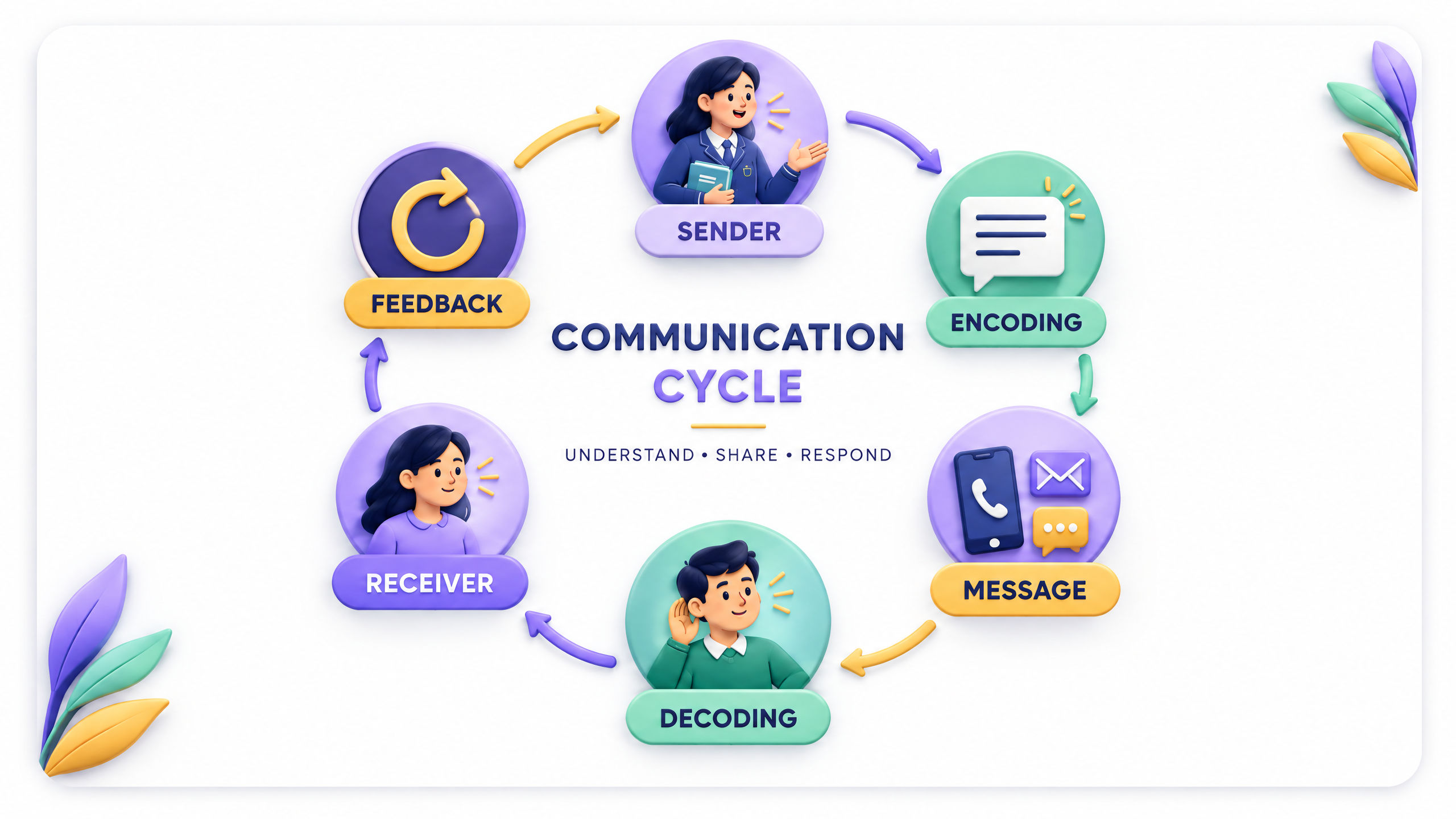
The word communication comes from the Latin word communicare, meaning “to share”. Communication is the process of sharing information, ideas, thoughts or feelings so that another person understands the intended meaning.
The communication cycle
Methods of communication
| Method | Meaning and suitable use |
|---|---|
| Face-to-face | Useful for personal discussion, quick clarification and situations where body language helps. |
| Useful for quick communication, sending documents and keeping a written record. | |
| Notice or poster | Useful when the same information must reach a large group. |
| Business meeting | Useful for group discussion, planning and organisational decisions. |
| Phone call or message | Useful when information must be shared quickly across distance. |
| Newsletter or blog | Useful for sharing updates, articles or information with many readers. |
The best method depends on the target audience, cost, type of information and urgency or priority.
2. Communication through words
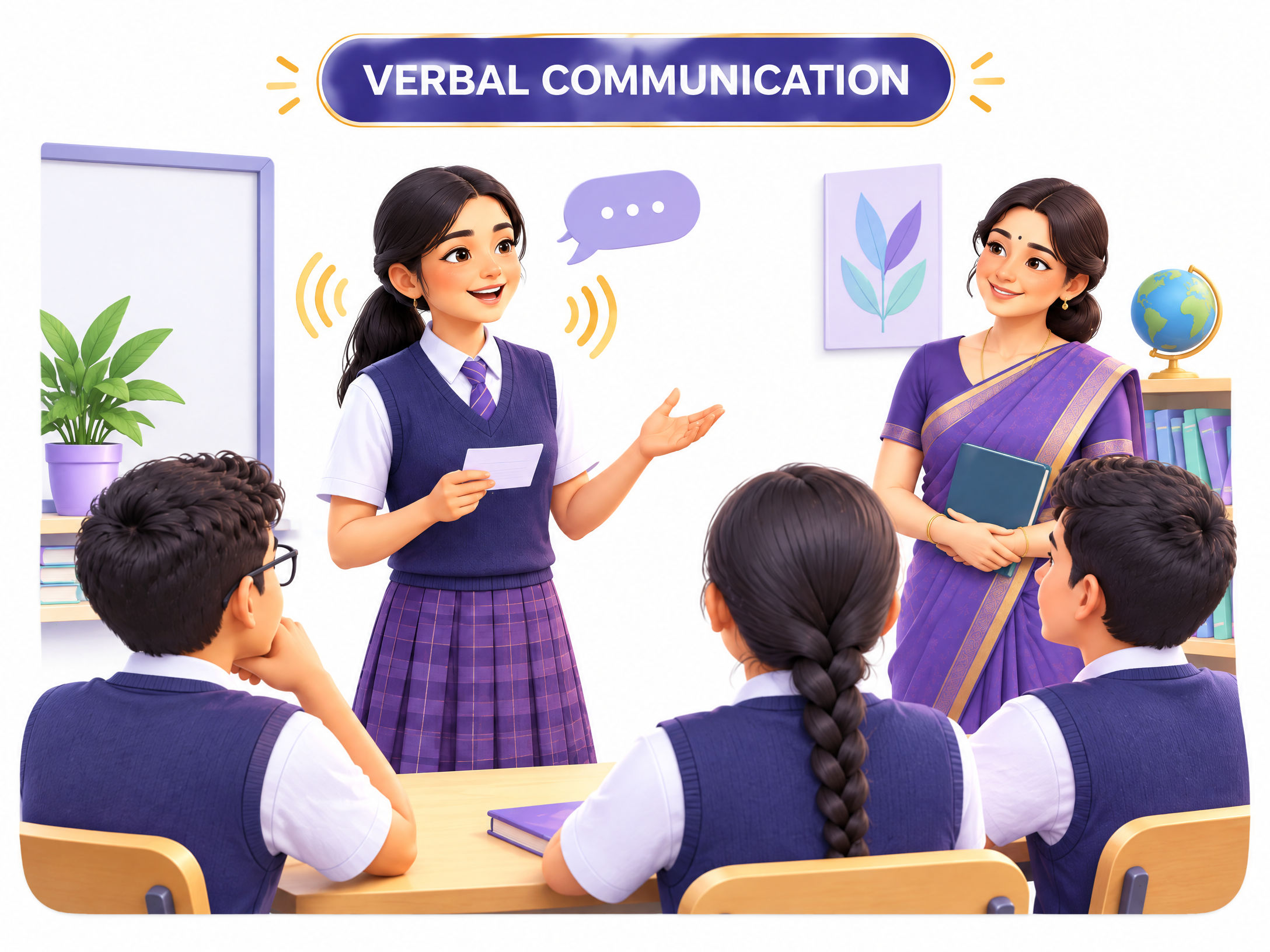
Verbal communication uses spoken or written words. It helps people exchange ideas, express feelings, give instructions and build relationships.
| Type | Explanation | Example |
|---|---|---|
| Interpersonal | Communication between two individuals. It can be formal or informal. | A teacher discusses a student’s performance. |
| Written | Communication through written words, such as letters, reports, emails and messages. | A manager sends an appreciation email. |
| Small group | Communication among more than two people where participants can interact. | A team meeting or classroom group discussion. |
| Public | One person communicates with a large gathering. | A speech at an assembly or public awareness programme. |
Advantages and limitations
Verbal communication allows quick exchange of ideas and immediate response. It also allows the speaker to change the explanation according to the listener’s reaction. However, unclear words, difficult jargon, poor pronunciation or an unsuitable tone can create confusion.
3. Communication without spoken or written words
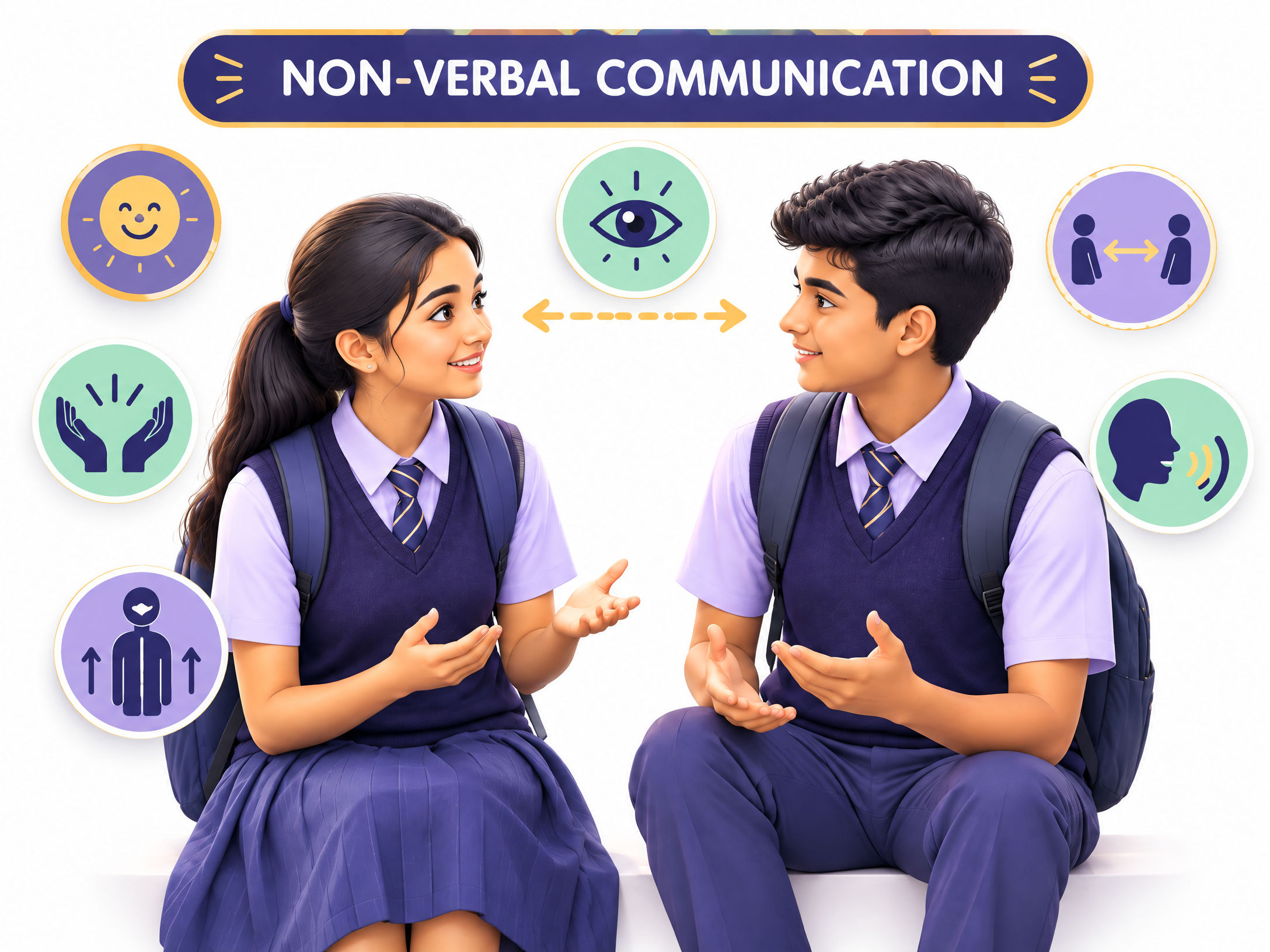
Non-verbal communication is the exchange of information through expressions, gestures, posture, touch, personal space, eye contact and voice qualities. It often supports, changes or sometimes contradicts spoken words.
| Element | What it communicates | Suitable practice |
|---|---|---|
| Facial expressions | Happiness, sadness, confusion, surprise or anger. | Keep the expression suitable for the situation. |
| Gestures | Greeting, direction, emphasis or agreement. | Use natural gestures; avoid threatening movements. |
| Posture | Interest, confidence, boredom or carelessness. | Sit or stand straight and remain attentive. |
| Eye contact | Attention, confidence and interest. | Look naturally at the speaker without staring. |
| Touch | Greeting, encouragement or relationship. | Respect personal and cultural boundaries. |
| Space | The distance maintained between people. | Maintain suitable distance in formal situations. |
| Paralanguage | Tone, pitch, volume, pauses and speed of voice. | Use a calm, clear and audible voice. |
4. Listening, barriers and the 7 Cs
Listening is more than hearing sounds. It means paying attention, understanding the message and responding appropriately. A good listener maintains attention, avoids unnecessary interruption, asks relevant questions and gives useful feedback.
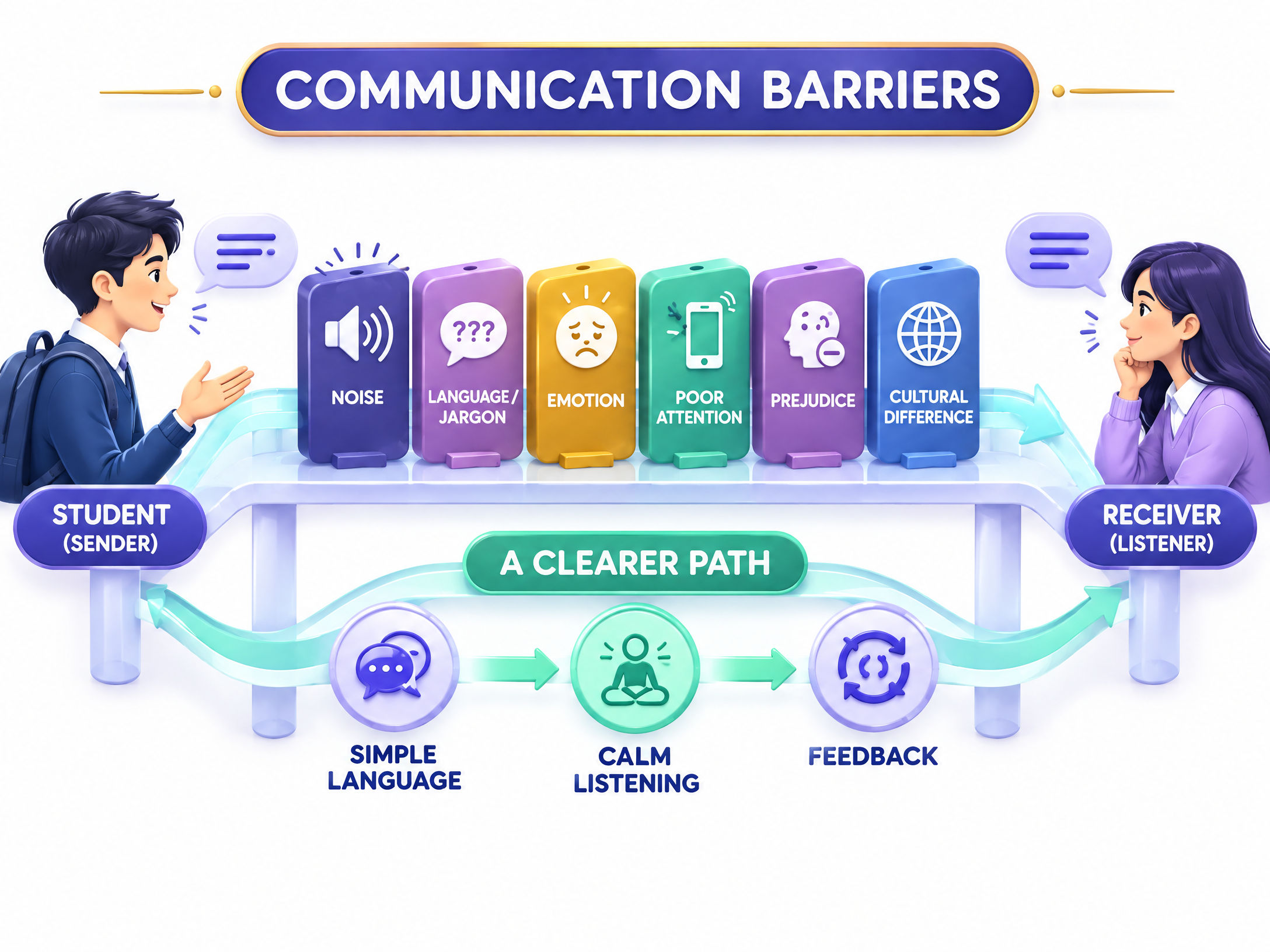
Common barriers to communication
| Barrier | How it creates difficulty | How to reduce it |
|---|---|---|
| Language | Different languages, difficult vocabulary or jargon. | Use simple words and explain unfamiliar terms. |
| Environmental | Noise, poor network, heat or an uncomfortable place. | Choose a suitable place and check the connection. |
| Emotional | Anger, fear, sadness or anxiety affects understanding. | Remain calm and choose the right time to talk. |
| Personal | Low confidence, poor attention or lack of interest. | Build confidence and listen actively. |
| Perception and prejudice | Judging a person or message through fixed assumptions. | Listen to the complete message before deciding. |
| Cultural | Words or gestures may have different meanings in cultures. | Respect differences and ask for clarification. |
The 7 Cs of effective communication
5. Writing clearly and correctly
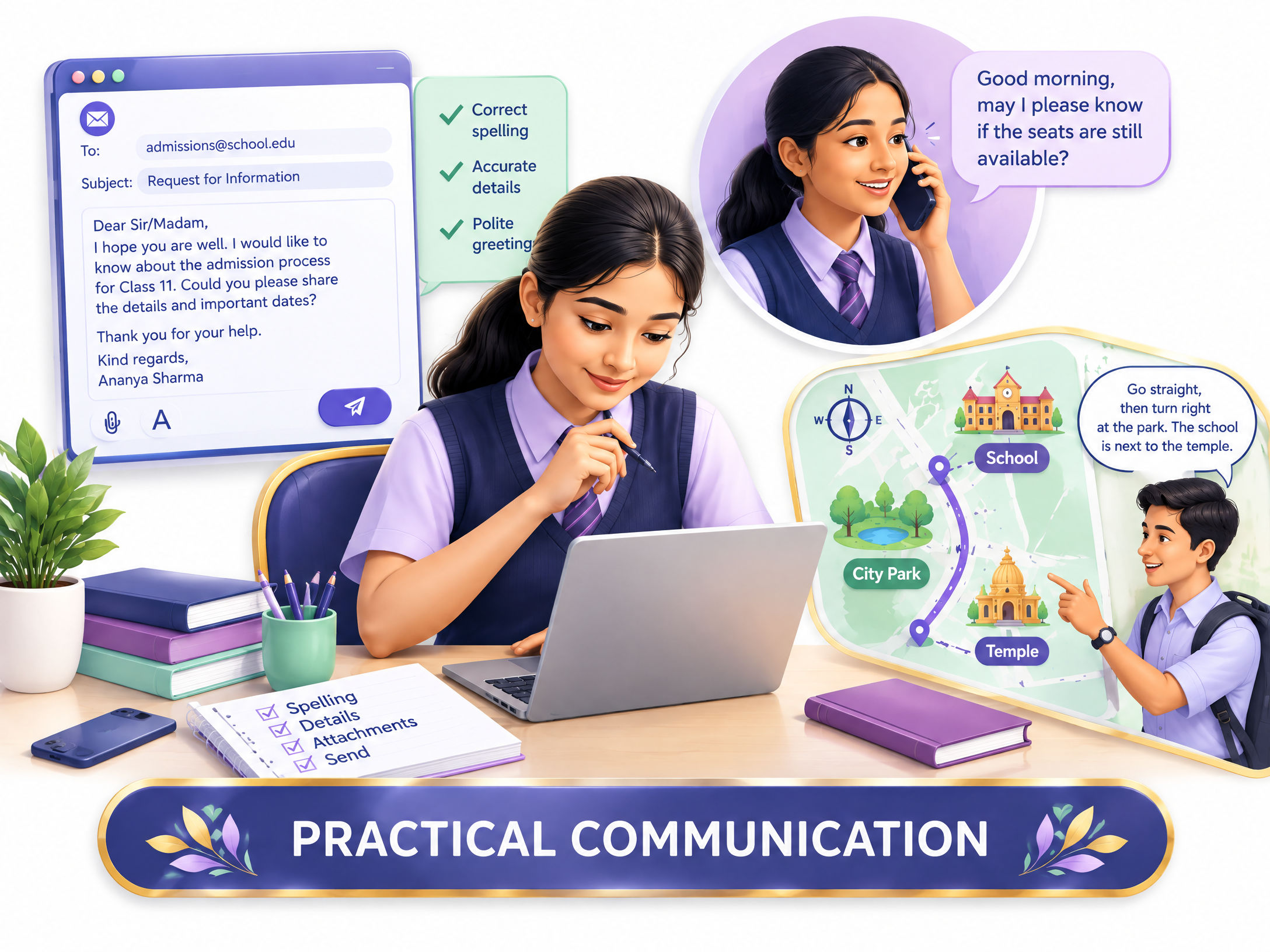
Good written communication is organised, accurate and easy to read. Begin with the purpose, arrange ideas in a logical order, use suitable paragraphs and check spelling and punctuation before sending the message.
Sentence basics
A sentence expresses a complete thought. The subject tells who or what performs the action, the verb tells the action or state, and the object receives the action.
| Sentence | Subject | Verb | Object |
|---|---|---|---|
| Riya reads the notice. | Riya | reads | the notice |
| The teacher gave us homework. | The teacher | gave | us homework |
| Arun opened the file. | Arun | opened | the file |
Active and passive voice
In active voice, the subject performs the action: “The student completed the project.” In passive voice, the subject receives the action: “The project was completed by the student.” Active voice is usually direct and easy to understand. Passive voice is useful when the action or result is more important than the doer.
6. Applying communication skills
Communication skills are used in greetings, telephone conversations, form filling, asking questions, giving directions and describing daily routines. Use a polite greeting, introduce yourself when needed, explain your purpose, ask clear questions and close the conversation respectfully.
| Situation | Useful language |
|---|---|
| Greeting | “Good morning. How may I help you?” |
| Asking an open question | “What information do you need?” |
| Asking a closed question | “Have you submitted the form?” |
| Giving directions | Use landmarks and words such as next to, opposite, between and across. |
| Refusing politely | Give a respectful reason and, if possible, offer another option. |
Before submitting a form, read every field carefully, write accurate information and check dates, spelling and contact details. In a telephone conversation, speak clearly because the listener cannot see your gestures or facial expression.